Seaweed in fashion: from a crewneck in Brooklyn to the labs still figuring out what comes next

Pick up an Oliver Charles summer crewneck and the tag says SeaCell™ and organic cotton. Customers describe it as silky, cooler than expected, softer than anything with no synthetic content. What isn’t known to everyone is where the seaweed in it was grown, how it became a fiber, or why it needs the cotton.
Those questions now have practical answers as seaweed fiber has crossed from concept to commercial production in the past few years. The more interesting story is the gap between what's already in your wardrobe and what the field is still figuring out.
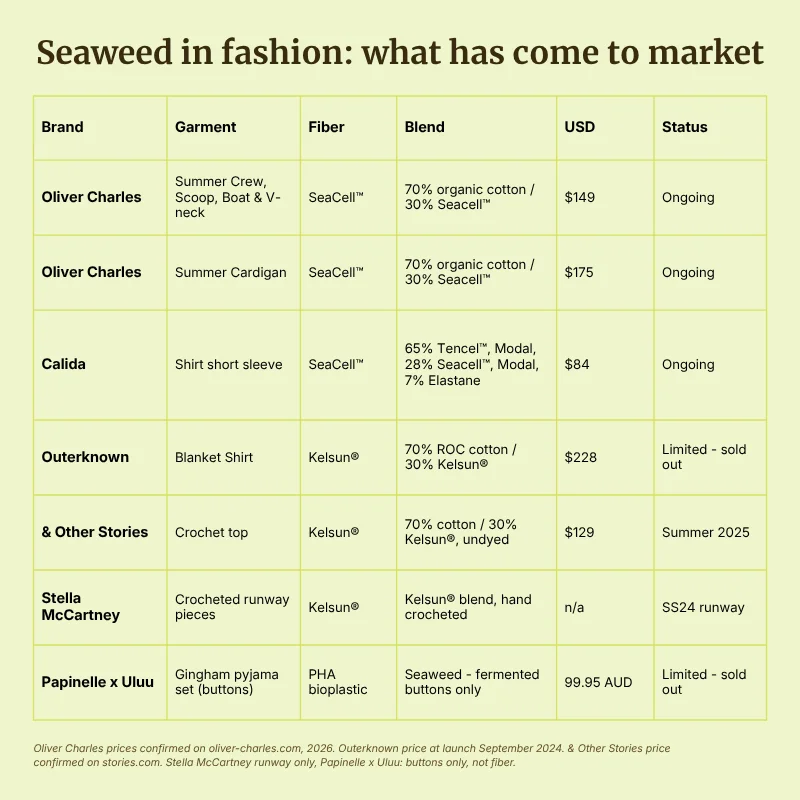
She sells seaweed: products that have come to market
This table tells you that the commercial landscape is wider than most people realize. SeaCell™ has been in continuous production long enough to anchor a full range while Kelsun has runway credibility and high street placement, while building toward sustained retail. And seaweed has found its way into pyjama buttons.
Why does seaweed need a partner and where does it come from?
None of the seaweed fibers in production today arrive at a brand ready to use on its own. All of them need a structural partner to become something that can be spun, knitted, dyed, and survive a washing machine.
SeaCell: a seaweed folded into Lyocell
SeaCell™ starts with Ascophyllum nodosum, a brown macroalgae harvested off Iceland on a four-year harvest cycle. It gets dried, milled to a fine powder, and folded into the Lyocell yarn solution before spinning, becoming part of the fiber itself rather than a coating on top. SmartFiberAG developed the process; Lenzing AG in Austria produces it. The seaweed accounts for roughly 19% of the finished material by volume. Since Lenzing makes SeaCell™ on the same infrastructure as Tencel, any mill set up for Tencel can handle SeaCell™ without retooling, a more significant advantage than it sounds. Getting a new fiber onto existing machines without forcing a mill to rebuild its process is one of the harder problems in bringing a new material to market, as BioFur found when developing their bio-based faux fur. Swiss brand Calida has used Seacell™ in underwear and loungewear while Oliver Charles built an entire summer range around it.
Kelsun®: seaweed biopolymer spun directly
Keel Labs’ Kelsun® takes a different route. Instead of adding seaweed to an existing fiber, Keel Labs extracts alginate, a natural polymer found inside kelp, and wet-spins it into fiber. It’s 100% biobased, always blended with cotton in garments. The technical distinction matters: SeaCell is Lyocell that carries seaweed; Kelsun® starts from the seaweed polymer itself. Brown kelp comes from ocean coastlines like South America and is processed at Keel Labs’ facility in North Carolina. Textile Exchange named it Innovation of the Year in 2024; INDA gave it the RISE Innovation Award in October 2025. Brands source it directly from Keel Labs. The blend ratio, incidentally, is how most new fibers earn their place. Brewed Protein™ tested well as a 10% blend in a cotton knit before Untouched World and Spiber could have a conversation about going further.
Karma Beach Club and PhycoLabs: different approaches and at different stages
Karma Beach Club, a small Hong Kong-based brand, blends 15% ocean-farmed kelp with organic cotton using an alginate-spinning process from the University of Qingdao, shipping directly to customers. Brazilian startup PhycoLabs is working on threads purely from seaweed, no cotton or Lycocell required, using red macroalgae from warm Brazilian coastal waters. It’s pre-commercial, but it appeared at Biofabricate and the Global Fashion Summit in 2024.
What it means when a launch sells out and doesn’t come back
There’s a pattern worth naming: a new seaweed product launches, sells, and often doesn’t come back. The Outerknown Blanket Shirt sold out and wasn’t restocked. The & Other Stories crochet collection was Summer 2025, not a permanent range. The Papinelle pyjama set with Uluu’s seaweed-fermented PHA buttons was a limited edition.
In practice, that indicates that the material did work, it just means the supply chain isn’t built to run continuously at volume yet. A limited-run collaboration at this stage is a proof of concept with a price tag: the brand learns whether consumers will buy it, and the material company learns whether the fiber holds up on standard machines with real washing cycles. That information is what makes the next conversation about volume, consistency, and price at scale a possibility.
The other ways algae is already in your closet
Seaweed fiber gets most of the attention, but algae has been making its way into fashion through other avenues that most people wearing them have never questioned.
Living Ink: the algae printed on your hang tag
Living Ink Technologies turns algae biomass waste into carbon-negative black pigment and printing inks. Their Algae Black™ and Algae Ink™ products, OEKO-TEX certified, have been used by Stella McCartney, Patagonia, GANNI, Nike, and New Balance, among others. Living Ink also printed the Kelsun® T-shirt Keel Labs used to demonstrate their fiber at industrial scale - two algae-derived materials in the same garment. This is microalgae, not seaweed: algae biomass waste from farms rather than ocean-grown macroalgae.
Zeefier: seaweed as dye
Dutch company Zeefier uses macroalgae (seaweed), to make industrial textile dyes for fashion brands across Europe, integrating into existing dyeing systems without new equipment. The color range is wider than you’d expect with purples, pinks and warm ochres. The one limitation is that the colors shift subtly over time, which is a characteristic of natural dyes, and something brands design around rather than fight.
Algix (Bloom): algae in the sole of your shoe
Algix’s Bloom technology turns microalgae harvested from polluted freshwater lakes into foam for footwear soles and midsoles. In production since 2016, it’s been used by Adidas, Merrell, Vivobarefoot, and several other brands. It’s probably the most widely distributed algae-derived material in fashion, and almost nobody wearing it knows it's there.
Where seaweed goes from here
Seaweed has gone from a fiber you’d find in a handful of specialist garments to one with a runway history, a high-street placement, and enough commercial proof points that serious research money is now following it. SeaWeave, a six-country European consortium running through 2028, is working to convert Atlantic and Mediterranean macroalgae into commercial fibers and dyes at scale. Early R&D on seaweed-based leather alternatives is underway too. The material is finding more than one way in.
What's remarkable is how much has already been worked out for a plant that has been growing in the ocean for millions of years — the harvesting, the processing, the blending, the supply chains all had to be figured out from scratch. Fashion is still in the early chapters of what seaweed can do, and by the looks of it, there’s a lot more to be written.
More articles

July news round-up: Nylon, nylon, BioPuff®
New bionylon collaborations, from waste wood to athleisure, Imperial College London bets on bio, and a biomaterials favorite says goodbye.

June biotextile round-up: silk, spandex, and cellulose
Biotech headlines that caught our eye: high yield silk alternatives, a step closer to bio-spandex, and cellulose cases for your cards and phone.

Bio-based embellishment: The button, bead, sequin, and feather makers changing fashion
Fabrics and dyes make headlines, but other biofashion innovators are looking at the little things.

Become an insider
Stay in the loop on the latest updates.